


Understanding the invisible reflection that matters.
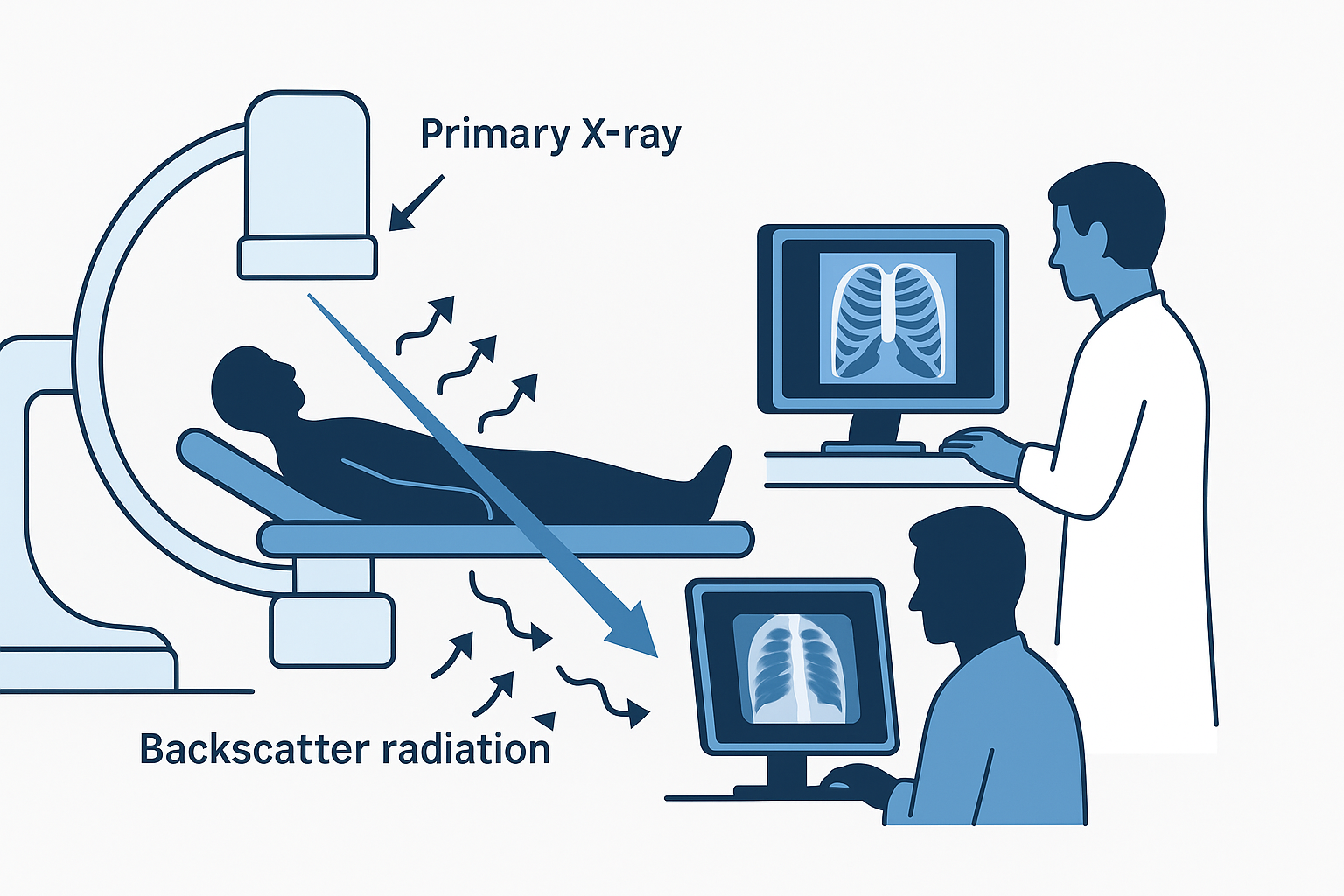
In every X-ray, fluoroscopy, or interventional procedure, not all radiation travels straight from source to detector.
Some photons bounce back — reflecting off the patient, table, or shielding surfaces — and return toward the operator. This reflected component is known as backscatter radiation.
Though invisible and secondary, backscatter contributes significantly to occupational exposure for doctors, nurses, and technicians.
Understanding how it occurs — and how to control it — is essential for both radiation safety and ergonomic protection.
What Is Backscatter Radiation?
Backscatter refers to X-ray photons that change direction after striking a dense object and are deflected backward toward the source or operator.
In medical imaging, these photons emerge primarily from:
- The patient’s body surface
- The examination table
- Floor and wall reflections
- Protective aprons or shields with high-density surfaces (e.g., pure lead)
While their energy is lower than the primary beam, backscattered X-rays can still penetrate unshielded body parts and contribute to cumulative dose exposure over time.
Why Backscatter Happens
The degree of backscatter depends on several factors:
- Atomic Number (Z) of the Material
Dense materials like lead (Z=82) produce more backscatter because they strongly reflect photons at diagnostic energy levels (70–120 kVp). - Angle of Incidence
Photons striking surfaces at shallow angles are more likely to reflect backward. - Surface Composition and Finish
Smooth, reflective surfaces enhance scatter reflection; matte or composite textures diffuse it. - Beam Energy and Filtration
Higher-energy beams produce deeper penetration but also increase scatter potential within shielding layers.
The Occupational Risks of Backscatter
While backscatter levels are small compared to direct radiation, continuous daily exposure can accumulate over years, particularly for interventional specialists.
Health Risks Include:
- Increased radiation dose to head, arms, and lower extremities
- Cataract formation from scattered exposure near the eyes
- Red bone marrow dose accumulation leading to cellular damage
- Cumulative stochastic effects, including long-term genetic and tissue risks
According to studies in interventional cardiology, up to 20–30% of total occupational exposure can come from secondary and backscattered radiation, underscoring the need for effective control.
Controlling Backscatter Radiation
Reducing backscatter requires both material innovation and operational awareness. Zittron integrates both into its product philosophy and design standards.
1. Use of Lead-Free Composite Materials
Traditional lead aprons tend to reflect radiation backward, increasing local scatter.
Lead-free materials, such as those used in Zittron’s Verde range, feature bismuth, tungsten, and tin-based composites that:
- Absorb more efficiently
- Emit minimal secondary fluorescence
- Reflect less radiation toward the wearer
This results in measurably lower backscatter levels around the apron’s surface.
2. Surface Engineering & Texture Control
Zittron’s ergonomic aprons use low-reflective outer fabrics and multi-layer construction to diffuse photon interactions rather than reflect them.
This design ensures that any residual scatter is scattered away from critical body zones, protecting the operator’s torso and spine.
3. Optimised Beam Angles & Operator Positioning
Clinical best practices also play a vital role in reducing backscatter exposure:
- Maintain maximum distance from the X-ray source
- Stand at oblique angles to the beam path instead of directly behind or beside the patient
- Use ceiling-suspended lead glass shields to deflect upward scatter
4. Regular Equipment Calibration
Proper beam collimation and filtration reduce unnecessary scatter.
Modern fluoroscopy units with pulsed or low-dose modes generate significantly lower scatter radiation when properly calibrated.
Zittron’s Backscatter Advantage
At Zittron, our design philosophy extends beyond primary protection.
Every apron and accessory is engineered to counter both primary and secondary radiation hazards, including fluorescence and backscatter.
Verde: The Anti-Backscatter Shield
- Lead-free composite layers for minimal reflection
- Multi-element shielding that dissipates photon energy internally
- Matte-finish outer surface to reduce secondary scatter
- Lightweight design for ergonomic comfort and all-day wear
By addressing both incoming and reflected radiation, Zittron ensures comprehensive protection — not just shielding, but scatter control.
The Science Behind the Verde Advantage
In tests simulating fluoroscopy conditions (at 100 kVp beam energy):
- Lead aprons reflected up to 10–12% of incident scatter back toward the operator.
- Verde’s lead-free composite materials reduced that reflection to below 3%, while maintaining equivalent attenuation.
This demonstrates that effective protection is not just about blocking radiation — it’s about managing its behaviour after impact.
Final Word: Shielding Beyond the Surface
Backscatter radiation may be secondary in energy, but not in significance.
Ignoring it means overlooking one of the most persistent sources of occupational exposure in medical imaging.
By combining advanced composite science, ergonomic design, and low-scatter material engineering, Zittron’s Verde range represents the next generation of intelligent protection — lighter, safer, and scientifically smarter.
At Zittron, every product is Curated for Safety — protecting doctors not only from direct radiation, but from what comes back unseen.
👉 Explore Zittron’s Lead-Free Verde Range
👉 Learn how Zittron’s anti-backscatter designs redefine radiation safety in modern healthcare.
Subscribe to our newsletter
Get expert insights, product updates and the latest advancements in radiation protection delivered to your inbox.
Thank you! Your submission has been received!
Oops! Something went wrong while submitting the form.
By clicking Submit, you agree to receive newsletters, product updates, technical articles and marketing communications from Zittron. You may unsubscribe at any time. Your information will be handled in accordance with our Privacy Policy and Newsletter Terms.
Blog
Related posts
Explore more articles designed to help you protect better, work safer and stay informed.
Backscatter Radiation in Medical Imaging: Causes, Risks & Control Mechanisms
In every X-ray, fluoroscopy, or interventional procedure, not all radiation travels straight from source to detector. Some photons bounce back — reflecting off the patient, table, or shielding surfaces — and return toward the operator. This reflected component is known as backscatter radiation.
Events
Innovation
Products
View All

Fluorescence in Radiation Shielding Materials: How Secondary X-rays Impact Safety and Image Quality
In every X-ray and fluoroscopy environment, radiation protection garments play a vital role in safeguarding healthcare professionals from scatter exposure.
Events
Innovation
View All
Importance of Lead-Free Radiation Protection Aprons (Verde): Controlling Fluorescence and Backscatter
Traditional lead aprons have long been the standard for radiation shielding in X-ray and fluoroscopic procedures. However, with evolving material science and safety research, lead-free aprons like Zittron’s Verde are emerging as the new benchmark for modern protection.
Events
Products
Innovation
View All
Let’s Protect What Matters
Thank you! Your submission has been received!
Oops! Something went wrong while submitting the form.