

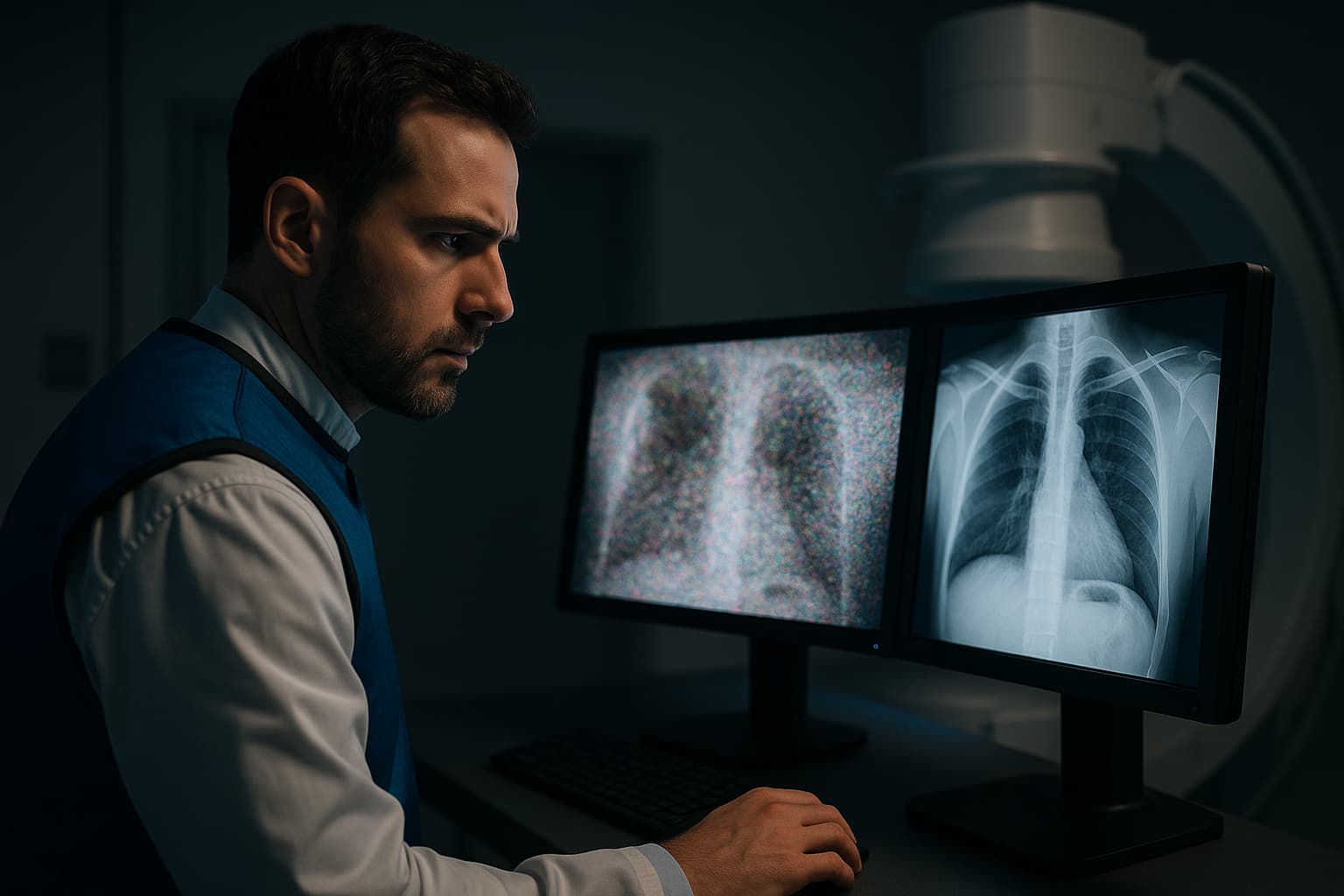
Redefining protection with safer materials and smarter science.

Traditional lead aprons have long been the standard for radiation shielding in X-ray and fluoroscopic procedures. However, with evolving material science and safety research, lead-free aprons like Zittron’s Verde are emerging as the new benchmark for modern protection.
Beyond being lighter and non-toxic, Verde aprons offer a key scientific advantage — they reduce fluorescence and backscatter radiation, two often-overlooked phenomena that can affect both safety and image quality.
Understanding Fluorescence and Backscatter
When X-rays strike dense materials such as lead, part of their energy is absorbed — but some is re-emitted as secondary radiation.
This re-emitted energy can take two forms:
1. Fluorescence
Fluorescence occurs when lead atoms re-emit X-ray photons after absorption.
These secondary photons can:
- Escape the protective barrier
- Contribute to stray radiation within the operating room
- Potentially affect the image receptor or personnel nearby
In short, while the primary beam is absorbed, a small amount of secondary “lead fluorescence” is created, adding to ambient exposure.
2. Backscatter
Backscatter refers to radiation reflected backward from the apron surface, patient, or surrounding objects.
Lead’s high atomic number increases this reflection effect, sometimes directing scattered photons toward the operator rather than away.
Both phenomena — fluorescence and backscatter — can increase occupational exposure and slightly degrade image contrast, especially in high-scatter environments like fluoroscopy or interventional radiology.
How Lead-Free Aprons Minimise These Effects
Lead-free shielding composites, such as those used in Zittron’s Verde aprons, replace pure lead with a balanced mix of bismuth, tin, tungsten, and antimony.
These elements have lower atomic numbers than lead, which fundamentally changes how they interact with X-ray photons.
🔬 Scientific Advantages of Lead-Free Materials
- Reduced Fluorescence Emission
- Non-lead composites generate minimal secondary radiation when struck by X-rays.
- This reduces internal scatter and fluorescence, providing cleaner attenuation.
- Non-lead composites generate minimal secondary radiation when struck by X-rays.
- Lower Backscatter Levels
- Lead-free compounds reflect less radiation toward the operator.
- The apron surface absorbs and dissipates X-rays more uniformly, lowering exposure to the wearer.
- Lead-free compounds reflect less radiation toward the operator.
- Enhanced Image Quality
- With minimal secondary emission, image contrast improves, particularly during digital fluoroscopy or angiography.
- With minimal secondary emission, image contrast improves, particularly during digital fluoroscopy or angiography.
- Eco-Friendly and Non-Toxic
- Free from hazardous lead, Verde aprons are environmentally safe, lightweight, and compliant with RoHS and REACH standards.
- Free from hazardous lead, Verde aprons are environmentally safe, lightweight, and compliant with RoHS and REACH standards.
Comparative Overview: Lead vs Lead-Free (Verde) Aprons
Verde aprons combine the attenuation efficiency of lead with the comfort and safety of advanced composites, offering the best of both worlds.
Why Fluorescence Control Matters for Doctors
Even low levels of secondary radiation, when accumulated over years, can contribute to occupational dose exposure — particularly around unshielded regions such as the head, neck, and extremities.
By reducing fluorescence and backscatter:
- Verde aprons lower stray dose exposure in the OR
- Minimise scatter contamination to nearby staff
- Maintain clarity of fluoroscopic imaging
- Ensure a safer working environment without added weight burden
This makes Verde especially valuable in high-exposure modalities like:
- Interventional Radiology (IR)
- Cardiac Catheterisation (Cath Lab)
- Orthopaedic Fluoroscopy
- Electrophysiology Procedures
Zittron Verde: The Smarter, Safer Alternative
At Zittron, innovation meets protection in the Verde series — our line of certified lead-free radiation protection apparel.
Verde Highlights
- Fluorescence-free composite layers for cleaner radiation attenuation
- Low backscatter surface finish for reduced operator exposure
- Lightweight ergonomic design for all-day comfort
- Eco-compliant materials — safer for users and the environment
- Available across aprons, thyroid shields, and accessories
Every Verde apron is tested and certified for compliance with IEC 61331-3 standards, ensuring equivalent radiation protection as traditional 0.25, 0.35, or 0.5 mm Pb aprons — without the drawbacks of lead.
Final Word: The Future Is Lead-Free
The importance of lead-free aprons goes far beyond comfort or compliance — it represents a scientific advancement in how radiation protection is achieved.
By reducing fluorescence and backscatter, Zittron Verde ensures not only superior safety but also environmental responsibility and operator comfort.
In the next generation of radiation protection, the question isn’t “How thick is the lead?”
It’s “How intelligently does it protect?”
At Zittron, every product — including Verde — is Curated for Safety, balancing physics, performance, and planet-friendly innovation.
👉 Explore Zittron Verde – Lead-Free Radiation Protection Range
👉 Contact us to learn how Verde helps you stay safer, lighter, and greener in every procedure.
Subscribe to our newsletter
Get expert insights, product updates and the latest advancements in radiation protection delivered to your inbox.
Thank you! Your submission has been received!
Oops! Something went wrong while submitting the form.
By clicking Submit, you agree to receive newsletters, product updates, technical articles and marketing communications from Zittron. You may unsubscribe at any time. Your information will be handled in accordance with our Privacy Policy and Newsletter Terms.
Blog
Related posts
Explore more articles designed to help you protect better, work safer and stay informed.

Backscatter Radiation in Medical Imaging: Causes, Risks & Control Mechanisms
In every X-ray, fluoroscopy, or interventional procedure, not all radiation travels straight from source to detector. Some photons bounce back — reflecting off the patient, table, or shielding surfaces — and return toward the operator. This reflected component is known as backscatter radiation.
Events
Innovation
Products
View All

Fluorescence in Radiation Shielding Materials: How Secondary X-rays Impact Safety and Image Quality
In every X-ray and fluoroscopy environment, radiation protection garments play a vital role in safeguarding healthcare professionals from scatter exposure.
Events
Innovation
View All
Importance of Lead-Free Radiation Protection Aprons (Verde): Controlling Fluorescence and Backscatter
Traditional lead aprons have long been the standard for radiation shielding in X-ray and fluoroscopic procedures. However, with evolving material science and safety research, lead-free aprons like Zittron’s Verde are emerging as the new benchmark for modern protection.
Events
Products
Innovation
View All
Let’s Protect What Matters
Thank you! Your submission has been received!
Oops! Something went wrong while submitting the form.