

Understanding the Global Standards for Radiation Protection Apparel
In the field of medical imaging and interventional radiology, radiation protection apparel—aprons, thyroid shields, head caps, and accessories—must not only perform but also prove their performance through internationally accepted standards.
The IEC 61331 series, developed by the International Electrotechnical Commission (IEC), defines how protective materials and garments are tested, evaluated, and certified for X-ray attenuation.
Among them, IEC 61331-1:2014 and IEC 61331-3:2014 are two cornerstone standards that govern how protection is measured and how it’s applied in practice.
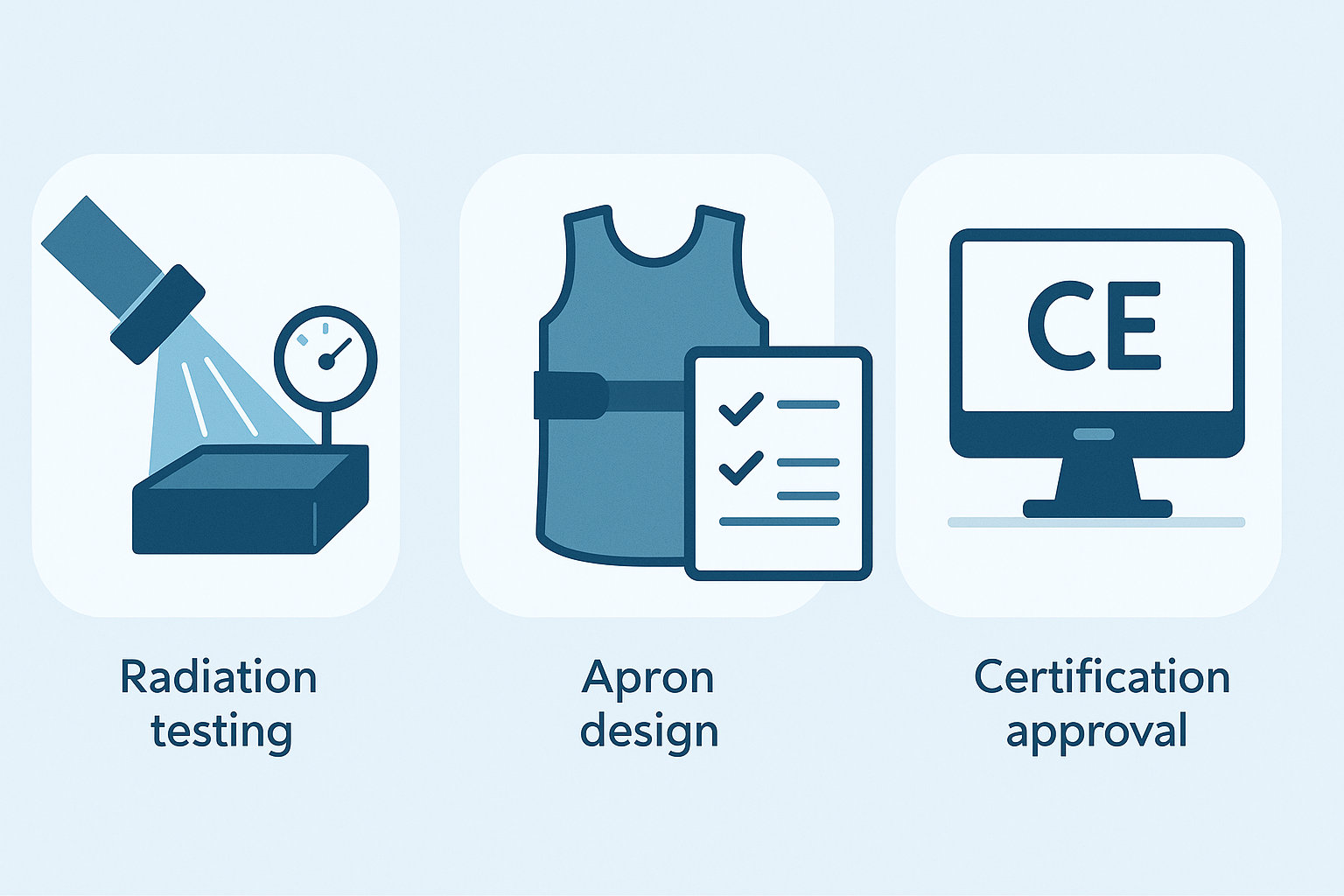
1. What Is IEC 61331-1:2014?
Methods of Test and Determination of Attenuation Properties
IEC 61331-1:2014 is the fundamental testing standard for radiation protection materials.
It specifies how to measure the shielding effectiveness—technically known as X-ray attenuation—of lead or lead-equivalent materials used in protective apparel.
Purpose
To establish accurate, reproducible methods for determining how much X-ray radiation is blocked by a given material.
Key Focus Areas
- Test Conditions: Defines beam qualities, energy levels, and geometry used for testing.
- Attenuation Coefficients: Determines how much radiation intensity is reduced after passing through the material.
- Lead Equivalence Measurement: Specifies how to express the protection level (e.g., 0.25 mm Pb, 0.35 mm Pb, 0.50 mm Pb).
- Reproducibility: Ensures all materials are evaluated under identical, standardized conditions.
Why It Matters
IEC 61331-1 ensures that every radiation protection material—lead-free, hybrid, or composite—is scientifically verified and globally comparable.
For manufacturers and users alike, it builds trust that the “lead equivalence” claimed on a label reflects proven attenuation performance.
2. What Is IEC 61331-3:2014?
Requirements for Protective Garments and Accessories
While IEC 61331-1 tests materials, IEC 61331-3:2014 focuses on the design, construction, and performance of complete protective garments used by medical personnel exposed to scattered radiation.
Scope
Applies to:
- Aprons and coats
- Thyroid and gonad shields
- Gloves, head, and lateral protectors
- Protective eyewear and curtains
Key Requirements
- Design Integrity: Garments must provide continuous, gap-free coverage across the body’s critical zones.
- Overlapping Areas: Defines how apron flaps and closures must overlap to maintain full protection (no dose “leakage”).
- Labeling and Marking: Every product must display its lead equivalence, energy test range, and standard reference.
- Ergonomic Performance: Encourages lighter, flexible designs that maintain protection without undue physical strain.
- Quality Consistency: Each batch of garments must meet identical performance metrics to remain IEC-compliant.
Why It Matters
IEC 61331-3 ensures real-world safety—confirming that not only the material but also the finished product delivers the intended protection level when worn by healthcare professionals.
3. How These Standards Work Together
Together, these standards create a closed-loop assurance system:
IEC 61331-1 verifies the science behind the material, while IEC 61331-3 ensures that the final garment upholds that science in daily clinical use.
4. Why Compliance Matters for Hospitals and Manufacturers
For Hospitals and Procurement Teams
- Guarantees that protective apparel is certified, tested, and globally validated.
- Enables fair comparison between brands using consistent international benchmarks.
- Reduces risk of occupational radiation exposure for staff through verified shielding performance.
For ManufZcturers
- Drives continuous R&D in materials and design innovation.
- Builds credibility and export eligibility in global markets.
- Ensures compliance with IAEA, ICRP, and local radiation safety regulations.
5. How Zittron Aligns with IEC Standards
At Zittron, every product—from aprons and thyroid shields to head and gonad protectors—is tested and validated under IEC 61331-1:2014 and IEC 61331-3:2014 parameters.
Whether it’s through innovations like:
- PinSafe™ stitch-free construction (for uninterrupted shielding),
- Reversible Series (for extended lifespan), or
- Hybrid Svelte material (for lighter, consistent attenuation),
each advancement is engineered to meet or exceed IEC-certified protection performance—ensuring safety that is both scientific and sustainable.
Final Word: Standards That Safeguard Lives
In radiation protection, compliance isn’t bureaucracy—it’s biology in action.
The IEC 61331-1 and 61331-3 standards define the science of shielding, ensuring that every apron, shield, or accessory you wear delivers measurable, verified protection.
When manufacturers innovate within these frameworks, they not only advance technology—they strengthen the trust that every healthcare professional places in their PPE.
At Zittron, that trust is our benchmark.
Because true protection begins where innovation meets compliance.
👉 Learn more about Zittron’s IEC-tested radiation protection solutions.
👉 Contact us to understand how IEC-certified materials like Svelte ensure safety, comfort, and reliability across clinical environments.
Subscribe to our newsletter
Get expert insights, product updates and the latest advancements in radiation protection delivered to your inbox.
Thank you! Your submission has been received!
Oops! Something went wrong while submitting the form.
By clicking Submit, you agree to receive newsletters, product updates, technical articles and marketing communications from Zittron. You may unsubscribe at any time. Your information will be handled in accordance with our Privacy Policy and Newsletter Terms.
Blog
Related posts
Explore more articles designed to help you protect better, work safer and stay informed.

Backscatter Radiation in Medical Imaging: Causes, Risks & Control Mechanisms
In every X-ray, fluoroscopy, or interventional procedure, not all radiation travels straight from source to detector. Some photons bounce back — reflecting off the patient, table, or shielding surfaces — and return toward the operator. This reflected component is known as backscatter radiation.
Events
Innovation
Products
View All

Fluorescence in Radiation Shielding Materials: How Secondary X-rays Impact Safety and Image Quality
In every X-ray and fluoroscopy environment, radiation protection garments play a vital role in safeguarding healthcare professionals from scatter exposure.
Events
Innovation
View All

Importance of Lead-Free Radiation Protection Aprons (Verde): Controlling Fluorescence and Backscatter
Traditional lead aprons have long been the standard for radiation shielding in X-ray and fluoroscopic procedures. However, with evolving material science and safety research, lead-free aprons like Zittron’s Verde are emerging as the new benchmark for modern protection.
Events
Products
Innovation
View All
Let’s Protect What Matters
Thank you! Your submission has been received!
Oops! Something went wrong while submitting the form.